

Wattage alone cannot tell you how much useful light red light therapy devices deliver to your skin: electrical power, wavelength, irradiance and coverage describe different things. For a home routine in 2026, choose a device by its documented output and practical setup, not by the largest wattage printed beside its name.
- Red light therapy devices need wavelength, irradiance and distance information; wattage alone cannot establish treatment dose.
- Suēle suits home buyers comparing red light therapy devices in lamp and panel formats.
- The Soleira Panel description lists 70 LEDs, including 660 nm red and 850 nm infrared LEDs.
- Choose a lamp or panel around your intended area, available space and the manufacturer's instructions.
Why this matters
A home routine needs somewhere to happen: a chair beside a socket, a clear place to position a device, and instructions you can follow without rearranging the room each time. A large wattage label answers none of those questions. Nor does it establish what reaches your skin.
For your 2026 shortlist, start with the area you want to expose and the setup you can accommodate. The guide to choosing red light therapy devices for your home provides a useful companion to the specification checks below. A device should fit your routine before its headline power becomes a deciding factor.
Why is wattage not the whole story for red light therapy devices?
Wattage describes power, but a product listing must explain which power it means. Electrical input, emitted optical power and the combined rated power of individual LED components are not interchangeable measurements. None, on its own, gives you the light intensity across your intended treatment area at your actual distance.
Suēle offers lamp and panel formats. The supplied descriptions support the following comparison, but they do not establish a measured irradiance advantage for either product.
| Device | Best for | Information stated in the supplied listing | Practical advantage | Limitation to check |
|---|---|---|---|---|
| Aurā lamp pro | Buyers considering a lamp format for facial or body use | Red and infrared light therapy; the description identifies facial and body use | A lamp format gives you an alternative to a panel-based setup | Confirm positioning, coverage and measured output before choosing it |
| Soleira Panel | Buyers considering a panel for a dedicated home routine | 70 LEDs: 35 at 660 nm red and 35 at 850 nm infrared | The description identifies the LED count and wavelength split | LED count and wavelength do not establish delivered dose or results |
These are format choices, not a performance ranking. The Soleira Panel's stated 70 LEDs describe its light sources, while the Aurā lamp pro description establishes its intended facial and body applications. Neither description justifies declaring a winner on treatment effectiveness.
What does a wattage label actually tell you?
A watt is a unit of power. The important buying question is whether the stated figure describes electricity drawn from the socket, light emitted by the device, or another rating used in the listing.
Electrical input includes energy used throughout the device, not just the light directed towards you. A component rating describes the component under specified conditions; it does not automatically describe how the assembled device operates. Optical output is a different measurement again.
When comparing devices in 2026, ask the seller to identify the measurement behind the wattage label. A useful answer explains what was measured and under which operating conditions. A repeated headline number does not resolve the distinction.
This does not make wattage irrelevant. Electrical consumption matters when planning use at home, and optical power is relevant to understanding light output. The mistake is treating an unexplained wattage figure as a complete measure of therapeutic performance.
Wavelength: what light does the device emit?
Wavelength describes the light itself, rather than how much electricity a device uses. Product specifications commonly express wavelength in nanometres, written as nm. Red and near-infrared light occupy different parts of the spectrum.
The Soleira Panel description lists 660 nm red LEDs and 850 nm infrared LEDs. It also specifies 35 red LEDs and 35 infrared LEDs. Those details are more informative than an unexplained power label because they identify the stated light sources.
However, an equal number of LEDs does not establish equal optical output from each wavelength. Nor does a wavelength specification show how evenly light reaches the exposed area. You still need output information and clear instructions for positioning the device.
Research on photobiomodulation examines particular wavelengths, doses, applications and outcomes. A study using a given wavelength is not automatically evidence for every consumer product using that wavelength. Matching a wavelength is not the same as matching a research protocol or proving a product's benefit.
Keep that distinction in mind when reading a product description beside a scientific reference. The question is not simply whether red light has been studied, but whether the cited work supports the specific claim being made.
Irradiance and exposure time: what reaches your skin?
Irradiance describes optical power arriving per unit of area. Device listings often express it in milliwatts per square centimetre, written as mW/cm². Unlike an electrical wattage label, an irradiance measurement concerns light reaching a specified measurement surface.
The distance matters. A reading taken close to a device cannot be treated as the reading at a different position, and measurements from different distances are not directly comparable. Measurement equipment and methods also affect how you should interpret a published figure.
Radiant exposure describes energy delivered per unit of area, commonly expressed in joules per square centimetre, or J/cm². For steady output, it depends on irradiance and exposure time. This explains why power alone cannot describe a session: the position and duration are part of the picture.
Do not turn that relationship into a homemade treatment schedule. Research protocols and manufacturer instructions address particular conditions, and longer exposure is not automatically better. Use the device's instructions rather than adding time to compensate for an output figure you cannot verify.
For a 2026 purchase comparison, ask for irradiance at the recommended use distance, the measurement method and any information about variation across the exposed area. A single strong reading is not a map of the whole light field.
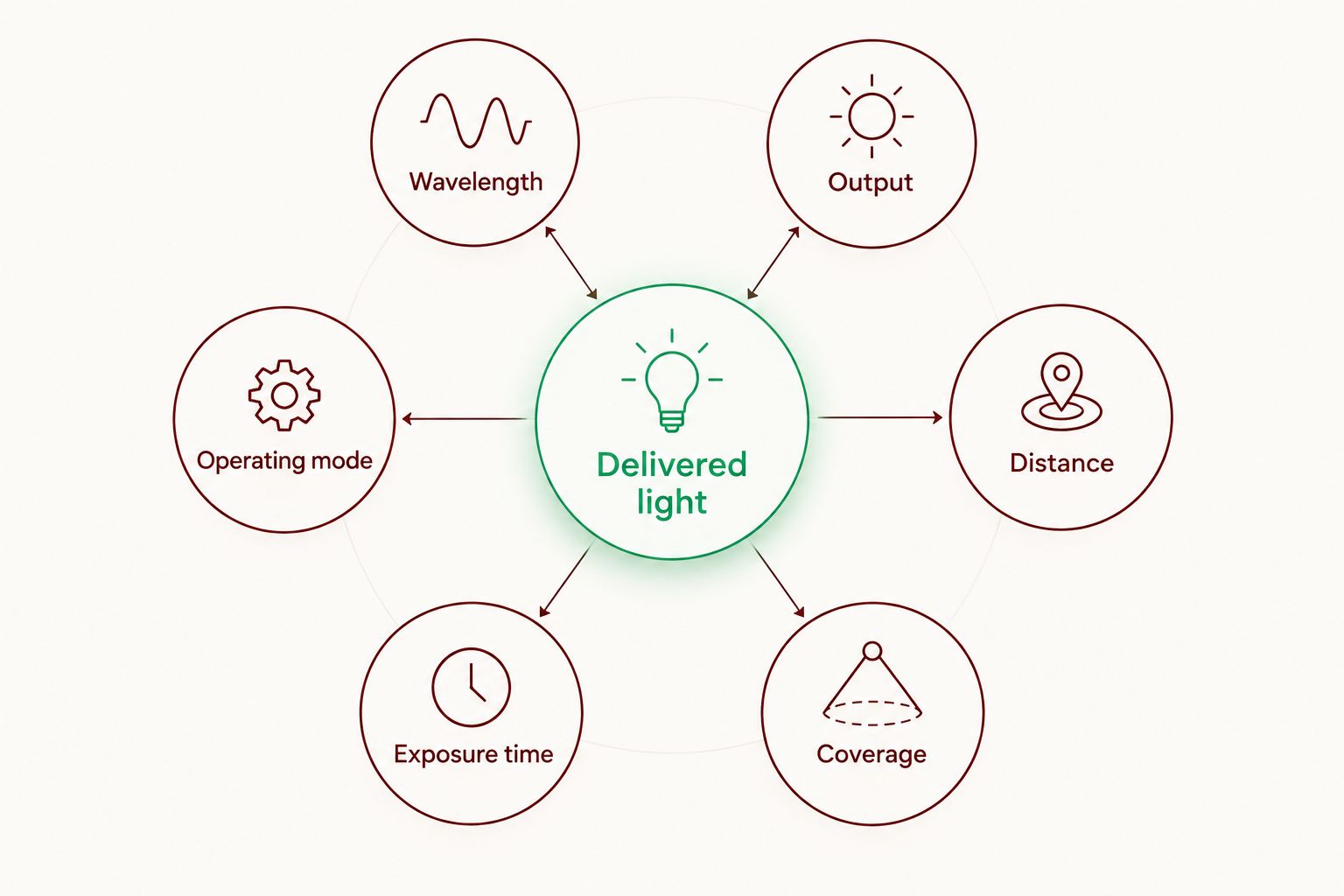
Why delivered light varies
Delivered light depends on more than the power rating. These factors explain why two devices cannot be compared fairly from wattage alone:
- Wavelength: The emitted spectrum identifies the light being used. Check which wavelengths operate in the mode you intend to select.
- Output: Electrical input and optical output describe different quantities. Establish which one the listing reports.
- Distance: Irradiance is tied to a measurement position. Compare figures taken at equivalent distances and follow the recommended setup.
- Coverage: A central measurement does not describe every point across the exposed area. Look for information about the usable light field.
- Exposure time: Duration contributes to radiant exposure. Follow the specified session instructions rather than assuming more time improves results.
- Operating mode: Continuous and pulsed operation describe different output patterns. Check which mode a quoted measurement represents.
This is a measurement framework, not a promise of a health outcome. Even clearly documented light output does not, by itself, prove a particular benefit for a particular user.
How do you compare devices for a home routine?
Use the same questions for every shortlisted device. This keeps a detailed listing from appearing better simply because it contains more technical language, and prevents a sparse listing from being filled out with assumptions.
- Choose the area. Decide whether your intended routine concerns your face or another body area. Check that the manufacturer's stated use covers that application; do not assume every format serves every purpose.
- Plan the space. Identify where you will sit or stand, how the device will be supported and where its cable will run. Confirm dimensions and mounting requirements from the current listing or manual.
- Read the light specification. Record the stated wavelengths and available modes. Keep wavelength information separate from wattage, LED count and claims about outcomes.
- Check the measurement. Ask what the power label means and whether irradiance is documented at the recommended distance. Keep the measurement conditions beside the figure when comparing devices.
- Read the instructions. Check session guidance, eye precautions, contraindications and cleaning requirements. A device that fits the room still needs to fit your circumstances.
- Confirm the product terms. For a South African home purchase, check the electrical requirements, support arrangements and product-specific warranty terms. Do not assume coverage is identical across a range.
Before buying in 2026, keep those answers together in a short comparison note. If a seller cannot explain a specification, leave that field unresolved rather than treating the largest number as the answer.
The following Suēle products are relevant to a lamp-versus-panel shortlist. The cards identify the products; they do not establish equivalent coverage, dose or clinical performance.


Does higher wattage mean better red light therapy?
Higher wattage does not, by itself, mean better red light therapy. Without knowing what the rating measures, the light delivered at the use distance and the intended application, you cannot translate a larger figure into a better outcome.
A higher electrical input can describe a device using more electricity without establishing a proportionate increase in useful light at your skin. Treat wattage as one specification to interpret, not a score to maximise.
Are more LEDs better than fewer LEDs?
More LEDs do not, by themselves, establish better performance. The Soleira Panel's stated 70 LEDs describe its construction; useful comparison still requires wavelength, output, arrangement and coverage information.
An LED count cannot replace a measurement of the light field. It also cannot prove that the device reproduces the conditions of a study cited in its marketing.
Can a red evening bulb replace a therapy device?
A red evening bulb is not automatically a substitute for a red light therapy device. Room lighting and a directed exposure routine serve different purposes, and colour alone does not establish wavelength-specific output or a treatment dose.
Keep ambient lighting decisions separate from therapy-device decisions. A comfortable room at dusk does not need to become a technical project, but a device sold for a targeted exposure routine needs clear use instructions and relevant specifications.
Keep evidence and safety separate from the specification sheet
Good documentation helps you understand a device. It does not remove the need to assess whether the intended use is appropriate for you. Research on a technology and evidence for a named consumer product remain separate questions.
Read the manual before the first session, including eye-safety guidance. Ask a clinician before use if you have a relevant medical condition, take medicine associated with light sensitivity, or intend to use the device for a diagnosed health problem. Do not use a purchase comparison as a treatment plan.
When reviewing claims in 2026, look for a stated outcome and research conditions rather than broad promises about wellness. No wattage, wavelength or LED count guarantees a result. A calm routine starts with knowing what the device is intended to do and where the evidence stops.
FAQ
What's the most useful specification when comparing red light therapy devices?
No single specification is sufficient: compare wavelength, irradiance at a stated distance, coverage and use instructions together. An unexplained wattage label cannot establish delivered dose.
Does a higher-wattage red light therapy device work better?
Higher wattage alone does not establish better performance. First check whether the figure describes electrical input, optical output or a component rating.
What wavelengths does the Soleira Panel list?
The Soleira Panel description lists 660 nm red and 850 nm infrared LEDs. It specifies 70 LEDs, split into 35 red LEDs and 35 infrared LEDs.
Why does the distance from a red light panel matter?
Distance matters because irradiance is measured at a particular position. Follow the device's positioning instructions rather than applying a reading from another distance.
Is a red light lamp better than a panel for home use?
Neither format is universally better for home use. Compare the intended area, positioning requirements, documented output and the space you can dedicate to the routine.
Can I extend a session to make a lower-power device more effective?
Do not extend a session simply to compensate for a lower power label. Exposure time contributes to dose, but the manufacturer's instructions should govern use.
Does research on red light prove that a particular device works?
Research on red light does not automatically prove the effectiveness of a particular device. The product's output, application and exposure conditions need to match the claim being supported.
One last thing
The most useful question to ask a seller is not whether a device is powerful. It is: what reaches the intended area when I use it according to the instructions? That question brings distance, coverage and output into the same conversation.
For a Suēle purchase, keep the current product description and manual beside your shortlist. Choose the format you can position correctly and use as directed, with claims you can distinguish from the wider research. A smaller number explained clearly is more useful than a larger number left undefined.