

Ask a clinician before using red light therapy devices if you take medicines with light-sensitivity warnings, have an eye condition or light-triggered symptoms, are pregnant, or want to treat an unexplained skin change or ongoing health problem. If you are receiving cancer treatment or recovering from a procedure, ask your treating team first; a quiet routine at home does not replace advice about your particular situation.
- Check red light therapy devices with a clinician when medicines, eye concerns or ongoing treatment complicate home use.
- Suēle sells home-wellness devices; product information does not replace an individual clinical assessment.
- Ask about the exact device, light modes, treatment area and eye protection—not just red light therapy generally.
- Keep circadian lighting separate from treatment decisions: an evening light bulb is not a therapy protocol.
Why this matters
A lamp beside your favourite chair can make a wellness routine feel ordinary. That familiarity is useful for building habits, but it does not answer whether a particular light device fits your medicines, skin or eyes. Make the safety decision before making the routine.
For a 2026 purchase, start with how to choose red light therapy devices for your home, then take any personal health questions to a clinician. Choosing a convenient format and checking suitability are different decisions. A product that fits your room still needs instructions you can follow.
For home-wellness shoppers, Suēle red light therapy devices belong alongside clinical advice, not in place of it. Research into light therapy also does not establish that every device, setting or intended use produces the same result.
When should you ask a clinician before using red light therapy devices?
Ask before the first session when your medical history, medicines or intended treatment raises a question the device instructions cannot answer. This is not a claim that everyone in these situations must avoid red light. It is a reason to obtain advice specific to the person, product and purpose.
Use this sequence before setting a device beside the sofa or adding it to your evening skincare routine:
- Check your medicines. Read the leaflets for prescriptions, non-prescription medicines and skin treatments. If a leaflet mentions photosensitivity or avoiding light exposure, ask a pharmacist or prescriber whether the warning applies to your device's wavelengths. A sunlight warning alone does not establish the answer for red or near-infrared light.
- Name the concern you want to address. Tell the clinician whether your goal is a general wellness routine or treatment of a symptom. Persistent pain, an unexplained rash, a changing skin lesion or a wound needs assessment rather than a trial of home treatment that delays diagnosis.
- Bring the exact device information. Show the product page and manual, including available modes, wavelengths, intended treatment area and eye-protection instructions. Advice about a clinic procedure is not automatically advice about a home lamp or mask.
- Describe relevant health circumstances. Mention pregnancy, eye disease, light-triggered symptoms, current cancer care and recent procedures. These details help the clinician decide whether you need further advice, a different approach or a pause before use.
- Get a clear plan. Ask whether the device is suitable, which modes to use, what protection is needed and which symptoms mean you should stop. Do not turn a general reassurance into your own exposure schedule.
What should you bring to the appointment?
Bring the manual, your medicine list and a short description of the area you want to expose. Include supplements and topical products when you describe your routine. A photograph of the device label is more useful than remembering that the box said red light.
For your 2026 buying checklist, keep the product name and instructions together. If a clinician asks for technical information that the product page does not provide, request it from the seller before proceeding. An unanswered safety question is a reason to wait, not a reason to improvise.
Compare the light modes, not just the device shape
A small lamp and a facial mask can both sound like simple home choices. Their light modes still need separate consideration. The supplied product information identifies the following wavelengths; those figures describe light, not a proven benefit or a suitable exposure time.
| Device | Best for this comparison | Stated light information | Practical advantage | Limitation to check |
|---|---|---|---|---|
| Aurā lamp pro | Red & Infrared Light Therapy | Shoppers considering a lamp format | The product URL identifies 660 nm and 850 nm | Lets you consider a lamp rather than a wearable format | Confirm positioning, exposure instructions and eye protection in the manual |
| Clarā Mask | Red, Infrared, Blue & Yellow Light Therapy | Shoppers considering a facial mask with several light modes | The supplied description lists 480 nm, 605 nm, 660 nm and 850 nm | Identifies several wavelengths for a mode-by-mode discussion | Do not apply advice about red light automatically to every available mode |
Suēle lists both lamp and mask formats. This comparison helps you prepare questions; it does not rank either product for treating a medical condition. Choose the format only after you understand its instructions and any personal restrictions.
The American Academy of Dermatology's consumer guidance on red light therapy discusses safety, eye protection and possible side effects. That general guidance is useful background for a 2026 decision, but it is not evidence that either named device is suitable for your individual circumstances.
Lamp formats: check placement and exposed areas
A lamp can sit within a familiar home routine, but its position should come from the instructions—not from whichever shelf looks convenient. Ask whether the intended treatment area, distance and eye protection fit the manufacturer's guidance. Do not borrow a setup from a photograph or another person's routine.
The appeal of a lamp format is that it does not require choosing a wearable device. Its practical limitation is that you must still establish the correct placement and exposure conditions. A comfortable chair does not establish a safe distance.
If you want to use a lamp on more than one area, explain that to the clinician. Advice about one patch of skin is not blanket approval for every body area. When the reason for use changes, the suitability question changes too.
Mask formats: check every mode and eye instructions
A mask brings the decision close to your eyes and facial skincare routine. Read the eye-protection instructions before deciding how to wear it, and ask your eye-care clinician if you have an existing eye condition or uncertainty about exposure. Closing your eyes is not a substitute for following the device's protection requirements.
The supplied mask description lists 480 nm, 605 nm, 660 nm and 850 nm. Those wavelengths span different parts of the light spectrum; a discussion about its 660 nm red mode does not answer every question about the other modes. Ask which mode the clinician's advice covers.
A wearable format can suit someone who prefers a facial device, but fit alone does not settle safety. Include your topical treatments in the discussion, especially when their instructions warn about irritation or light exposure. Do not stop prescribed skincare simply to accommodate a device.
Why advice varies between people and devices
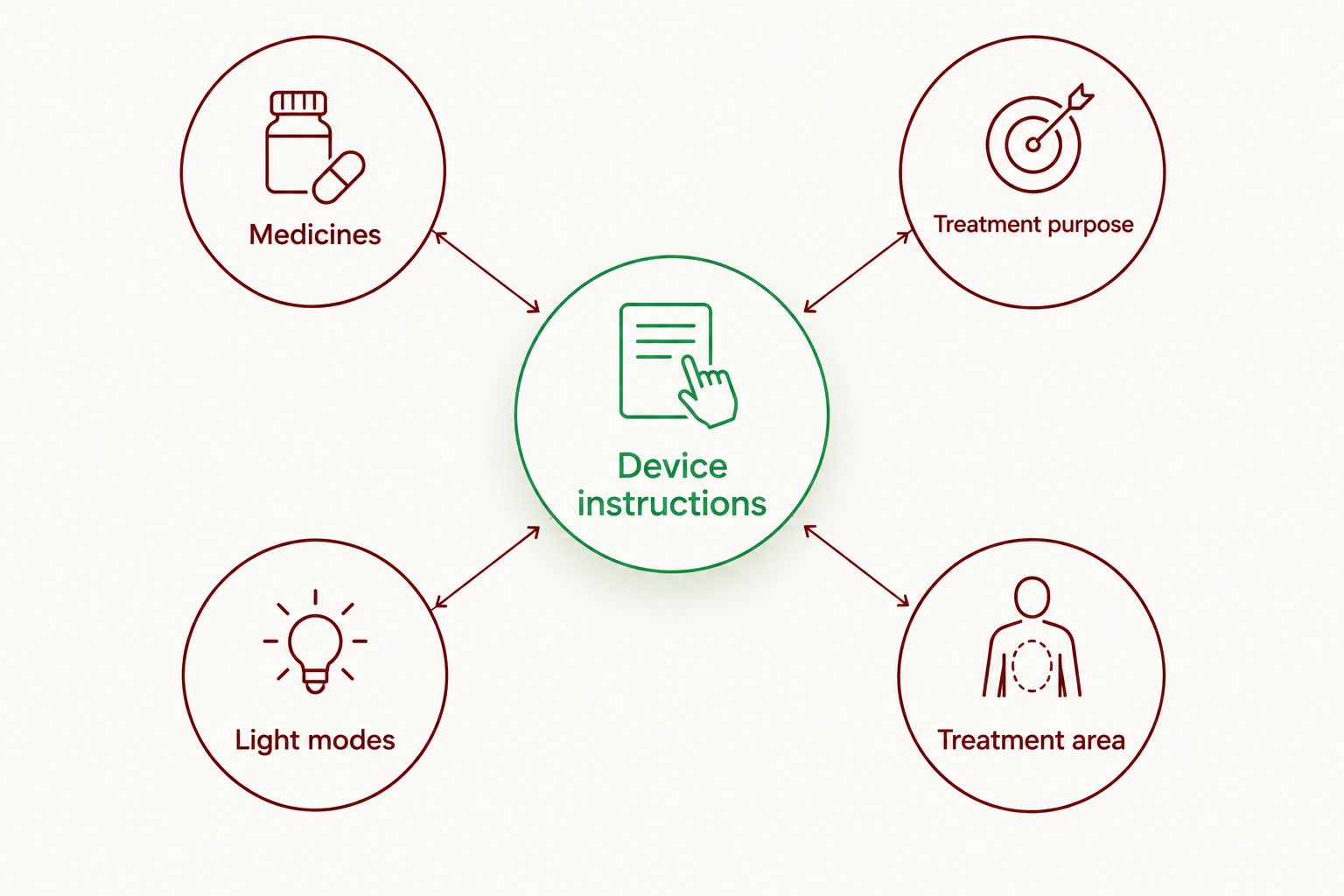
Personal advice depends on more than whether a product emits red light. These are the details to clarify before use:
- Medicines: A photosensitivity warning needs interpretation for the medicine and the relevant light spectrum. Your pharmacist can review the actual medicine rather than relying on a broad list found online.
- Treatment purpose: A wellness habit and an attempt to treat an unexplained symptom require different conversations. Get the symptom assessed first when diagnosis is the unresolved issue.
- Light modes: Red, near-infrared and other available colours are not interchangeable descriptions. Ask about the modes you intend to select.
- Treatment area: Facial use, use near the eyes and use over recently treated skin raise different practical questions. Describe the area rather than asking only whether red light is safe.
- Existing care: Pregnancy, ongoing cancer treatment, eye care or recovery from a procedure makes advice from the relevant treating professional important. A seller cannot coordinate that care for you.
- Device instructions: Positioning, protective equipment and warnings belong to the exact model. A session described for another product is not your operating manual.
This distinction remains useful in 2026: the technology's name is not a personalised safety assessment. Keep the discussion grounded in the device you own and the reason you plan to use it.
Does a photosensitivity warning mean I cannot use red light?
A photosensitivity warning means you should ask the pharmacist or prescriber before use; it does not, by itself, identify which wavelengths are relevant. Show the warning and the device information together. Do not stop taking a medicine to make room for a wellness routine.
A pharmacist is a practical first contact for a medicine question. A clinician managing the underlying condition should address whether home treatment fits the care plan. These are separate questions, and you can need answers to both.
Should I ask before use during pregnancy or cancer treatment?
Yes—ask your maternity clinician during pregnancy and your treating team during cancer care before starting home light treatment. Avoid interpreting either a wellness claim or a general research paper as personal clearance. State where you intend to use the device and why.
This advice is not a claim that all light therapy is prohibited in either situation. It keeps decisions with the professionals who know your circumstances. If their advice is to wait, keep the device out of the routine rather than modifying the plan yourself.
What if my skin or eyes feel uncomfortable during use?
Stop the session if you experience burning, eye discomfort or an unexpected reaction, and seek advice before restarting. Do not treat discomfort as proof that the device is working. Follow the manual's warnings and seek prompt medical care for severe symptoms or a change in vision.
Write down the mode used, the treatment area and what happened. That record gives a clinician something specific to assess. Starting again at a different setting without advice can obscure the original problem rather than resolve it.
Keep research separate from product claims
Light-therapy research examines particular wavelengths, exposure conditions, participants and outcomes. A result from one setting does not transfer automatically to every lamp, mask or routine sold for home use. Evidence for a technology is not proof of a particular product's medical benefit.
For a 2026 product comparison, ask what a claim refers to: the broader technology, a component or the complete device being sold. A phrase such as clinically validated needs supporting detail before it answers a purchase question. It does not replace instructions or establish suitability for a particular condition.
Also separate treatment devices from household lighting. Full-spectrum bulbs and evening lighting belong in a discussion about your home environment; they are not interchangeable with a red light therapy protocol. You can enjoy a calmer room without treating its atmosphere as medical evidence.
FAQ
Do I need a doctor's permission to use red light therapy devices at home?
Ask a clinician first when medicines, eye concerns, pregnancy, ongoing treatment or an unexplained symptom raise a suitability question. Always follow the exact device's warnings and instructions.
Can a pharmacist check whether my medicine is a problem?
A pharmacist can review a medicine's light-sensitivity warnings against the device information. Bring the medicine name, leaflet and available wavelengths; do not stop prescribed medicine yourself.
Is near-infrared light the same as red light?
Near-infrared light is not the same as visible red light. Ask about every mode you intend to use rather than treating advice about one wavelength as approval for another.
Can I use a red light mask if I have an eye condition?
Ask your eye-care clinician before using a light mask if you have an eye condition. Bring its manual and eye-protection instructions so the advice relates to the actual device.
Can I use red light on a changing mole or unexplained rash?
Get a changing mole or unexplained rash assessed before trying home light treatment on it. A device should not delay diagnosis or replace the treatment recommended after assessment.
Does research on red light prove a home device will help me?
Research on red light does not prove that a particular home device will help you. The studied device, exposure conditions and health concern need to match before a result supports that specific claim.
Should I keep using a device if it hurts?
Stop using the device if it causes pain, burning, eye discomfort or an unexpected reaction. Seek advice before restarting, and get prompt medical care for severe symptoms or vision changes.
One last thing
Take the instruction manual—not just the shopping link—to the conversation. The most useful answer is not simply that red light is suitable; it is whether your intended device, mode and treatment area fit your circumstances.
Before bringing a Suēle device into your 2026 home routine, settle those questions and keep the answers with the manual. Then the routine can remain simple: a considered place in your day, without asking a wellness product to make decisions that belong to clinical care.