

No—a full spectrum light bulb cannot replace time outdoors, even when it makes a room more comfortable to use. It provides indoor illumination, but it does not reproduce the changing brightness of daylight, the whole outdoor environment or the movement that often comes with stepping outside.
- A full spectrum light bulb complements daylight; it does not replace time outdoors.
- Suēle offers full-spectrum and red-spectrum lighting options; neither should be treated as sunlight replacement.
- Circadian lighting depends on brightness, timing and light reaching your eyes—not the product label alone.
- Choose home lighting around daytime tasks and evening routines, without expecting guaranteed sleep or health results.
Can a full spectrum light bulb replace time outdoors?
Use indoor lighting to support your home routine, not to replace outdoor daylight. A bulb can illuminate a kitchen table or reading corner. It cannot reproduce everything you experience on a walk, in a garden or beside an open stretch of sky.
For a home-lighting decision in 2026, separate these options by their intended role rather than treating them as interchangeable:
| Option | Best for | What it offers | What it does not establish |
|---|---|---|---|
| Outdoor daylight | Spending part of your day outside | Naturally changing light and an outdoor setting | A guaranteed health outcome or a universal exposure schedule |
| Solis bulb - Full Spectrum circadian lighting | Considering full-spectrum lighting for indoor spaces | A product presented as full-spectrum circadian lighting | Measured daylight equivalence or a proven sleep benefit |
| Solis bulb Red - Blue Light Blocking Light Bulb | Considering a red-spectrum lighting option | A product identified as a red, blue-light-blocking bulb | Verified spectral output, sufficient task brightness or a proven health benefit |
The two bulbs serve different lighting interests. Their names alone do not establish how much light reaches your eyes, whether they suit your existing fittings or how they perform in a particular room.
Why this matters
Picture a weekday at home: breakfast at the kitchen counter, work at a desk, then a quieter room after dinner. Those settings call for different lighting decisions. A single promise to bring natural light indoors does not answer all of them.
Light influences the body’s daily timing system, but that response depends on exposure. Brightness, spectrum, timing and duration matter together. A pleasing appearance is useful; it is not proof that a lamp reproduces daylight’s biological effects.
Suēle's full spectrum light bulb is best considered for indoor lighting, not as a replacement for time outdoors. That distinction keeps the purchase practical: choose a bulb for the room you need to light, while keeping outdoor time as a separate part of your routine.
What a full-spectrum label actually tells you
Full-spectrum language suggests a spread of wavelengths rather than a narrow band of colour. However, the phrase on a listing does not tell you the complete spectral output, the illumination at your chair or the effect of the lampshade around it.
Visible light is commonly described as spanning approximately 380 nm to 780 nm. That broad range explains why white light and a narrowly coloured light source are not the same thing. It does not mean every product described as full spectrum emits every wavelength evenly.
You also need to separate appearance from measurement. A bulb can look bright or daylight-like without delivering the same exposure as being outside. Your eyes adapt to the room, so perceived brightness is not a reliable substitute for measured light levels.
For a 2026 purchase, ask for the specification that answers your actual question. If you want to understand colour quality, look for colour-rendering information. If you want to understand circadian claims, ask what measurements support them and under which conditions they were taken.
Do not turn a missing measurement into a positive assumption. A product description can explain the intended use without proving equivalence to sunlight, a clinical effect or a particular improvement in sleep.
Why light exposure varies between indoors and outdoors
A bulb’s performance in your home depends on more than its name. These factors explain why replacing a light source does not automatically recreate an outdoor experience:
- Brightness at your eyes: light reaching you matters more than how bright the bulb looks when viewed directly. Fixture output and exposure at your seat are different measurements.
- Spectrum: different wavelengths contribute differently to visual appearance and biological responses. A full-spectrum label is not a complete spectral report.
- Timing: morning, daytime and evening exposure have different roles in a daily routine. The same lighting arrangement is not equally appropriate at every hour.
- Duration: a short visit to a room and a long period at a desk are different exposures. A product name does not account for how you use it.
- Placement and surroundings: distance, shades, walls and your position affect the light reaching your eyes. A measurement taken under one setup does not describe every home.
- Outdoor conditions: shade, cloud cover and the time of day change natural light. Outdoors is not one fixed brightness that a bulb can simply copy.
The practical consequence is straightforward: choose lighting for a specific setting and time of day. Avoid buying on the assumption that a familiar colour or a broad-spectrum claim makes all other exposure details irrelevant.
What the science supports—and what it does not
Light reaching the eyes helps regulate circadian timing. The International Commission on Illumination, known as the CIE, distinguishes light’s visual functions from its effects on daily biological rhythms. Its guidance concerns light exposure, not automatic approval of products carrying a circadian label.
For your 2026 decision, the useful lesson is that biological lighting claims need more than a photograph or a colour description. The amount, timing and spectral characteristics of exposure are part of the question. Room layout and actual use also matter.
Research on a technology is not evidence for every device using related language. A study of a measured lighting setup does not establish the same result for a household bulb in another fitting, at another distance, used on another schedule.
That distinction applies to Suēle lighting as well. A product positioned as full-spectrum circadian lighting should not be described as clinically proven to improve sleep unless evidence for that specific product supports the claim.
Look for a clear connection between the claim and its evidence. Does the research concern ordinary room illumination, a specialised light-therapy intervention or an entirely different technology? If those categories are blurred together, the purchase explanation is incomplete.
Choose your home lighting around the room
Start with a familiar setting rather than an abstract promise. At a dining table used for paperwork, you need to see clearly and comfortably. In a bedroom before sleep, you need enough light to move safely without making the room unnecessarily bright.
Use this sequence when comparing lighting in 2026:
- Room purpose: name the task first—reading, preparing food, working or winding down. A bulb chosen for atmosphere still needs to support the room’s practical use.
- Daylight access: consider where windows bring light into the room and where you usually sit. Indoor lighting can supplement a dim corner without replacing your outdoor routine.
- Product details: check the fitting, electrical requirements, light-output information and any dimming instructions. Do not assume compatibility from the product photograph.
- Evening use: decide how you will reduce unnecessary brightness later in the day. A separate lamp can be easier to control than lighting the entire room.
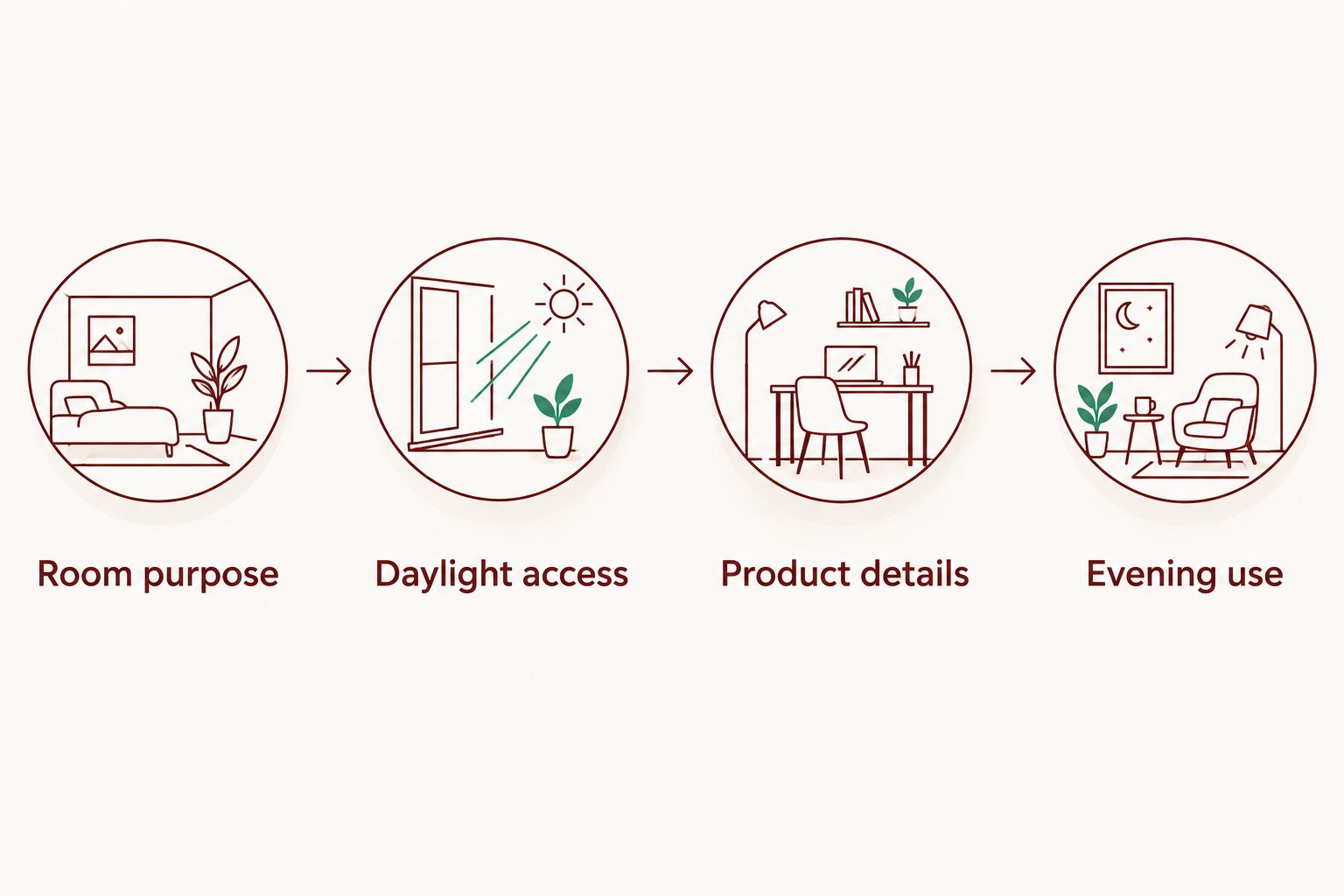
Before choosing either lighting option, confirm the details that affect your home. Suēle's product names identify different lighting categories, but they do not establish identical controls, fittings, warranty coverage or measured performance.


Can a full spectrum light bulb help your evening routine?
A full spectrum light bulb can provide indoor illumination, but the label alone does not establish that it suits your evening routine. Consider brightness, timing and the light reaching your eyes rather than expecting a guaranteed sleep result.
A calm evening room does not need to be completely dark while you are awake. It needs lighting that lets you finish ordinary tasks safely. Reduce unnecessary brightness, and avoid placing an exposed bright source directly in your line of sight.
Red-spectrum lighting is another category to consider, but colour alone does not establish an ideal exposure. You still need enough visibility for reading, stairs or preparing something in the kitchen. Safety and usable light come before creating a particular atmosphere.
Can a full spectrum light bulb give you vitamin D?
A full spectrum light bulb should not be relied on to produce vitamin D. Ordinary visible illumination and the ultraviolet exposure involved in skin production of vitamin D are different things.
The US National Institutes of Health Office of Dietary Supplements explains that UVB radiation enables vitamin D synthesis in skin. UVB is commonly defined as the 280 nm to 315 nm band—outside the visible-light range described above.
That distinction is not a recommendation to seek unprotected ultraviolet exposure. Sun exposure also carries skin risks, and a household lighting purchase is not a vitamin D treatment decision. If you are concerned about deficiency, discuss assessment and management with a qualified healthcare professional.
Is full-spectrum lighting the same as red light therapy?
Full-spectrum room lighting is not the same as red light therapy. Room lighting is used to illuminate a space; red light therapy involves a different intended use and requires its own device-specific instructions and evidence.
Do not transfer claims between the categories. A study involving targeted light exposure does not prove that a household bulb provides the same effect. Equally, a therapy device does not become suitable general lighting simply because it emits visible light.
If your goal is comfortable illumination for meals, work or reading, evaluate a lighting product. If your goal concerns a particular health condition, seek appropriate clinical advice rather than choosing a room bulb on the strength of therapy-related language.
Keep outdoor time and indoor lighting as separate decisions
You do not need to choose between a useful lamp and time outdoors. They answer different needs. Indoor lighting helps you use a room; going outside puts you in a different environment and can accompany movement or a break from seated work.
For a practical 2026 routine, attach outdoor time to something you already do when circumstances allow. Have a drink outside, step into the garden between tasks or take a walk at a suitable time. These are routine choices, not prescribed treatment doses.
Weather, mobility, work and personal safety affect what is realistic. When you cannot get outside, use your available indoor light thoughtfully without calling it equivalent to outdoors. A workable routine is more useful than an all-or-nothing standard.
Keep the purchase question narrow: will this bulb help you light the room appropriately? Keep the outdoor question separate: where does stepping outside fit safely into your day? Neither decision needs a promise of perfect biology to be worthwhile.
FAQ
Can a full spectrum light bulb replace sunlight?
No, a full spectrum light bulb cannot replace sunlight or the wider experience of being outdoors. Treat it as indoor illumination, not as proof of daylight-equivalent exposure.
Is a full spectrum light bulb the same as daylight?
No, a full spectrum light bulb is not the same as daylight. Spectrum, brightness at your eyes and changing outdoor conditions all affect the comparison.
Can I get vitamin D from a full spectrum light bulb?
Do not rely on a full spectrum light bulb for vitamin D production. Vitamin D synthesis in skin involves UVB exposure, which is different from ordinary visible room lighting.
Will a circadian light bulb definitely improve my sleep?
No, a circadian light bulb does not guarantee better sleep. Evidence must relate to the specific product and exposure conditions, not just to research on light in general.
Is a red bulb better than a full-spectrum bulb at night?
Neither label alone establishes which bulb is better for your evening setting. Compare the intended use, brightness, available controls and ability to see safely.
Do I still need to go outside if I use full-spectrum lighting?
Full-spectrum lighting does not remove the reasons to spend time outdoors. Outdoor conditions, movement and your wider routine remain separate from a room-lighting purchase.
What should I check before buying a full spectrum light bulb?
Check fitting compatibility, electrical requirements, light-output information and any dimming instructions. Ask for evidence supporting biological claims, and confirm the current terms for the specific product.
One last thing
The lampshade is part of the lighting decision. It changes where the bulb’s light goes, so the same bulb in an enclosed shade and an open fitting does not create the same exposure at your seat.
Before replacing a bulb, look at the whole setup: the fitting, your chair, the window and when you use the room. Choose lighting that belongs in that setting, and let time outdoors remain its own part of your day.