

Compare red light therapy devices by irradiance measured at the same distance, with the same wavelengths, operating mode and measurement method—not by wattage or LED count. Then check how evenly that output covers the area you intend to use; a strong reading directly in front of one LED does not describe the whole illuminated surface.
- Compare red light therapy devices using irradiance, measurement distance and coverage—not electrical wattage alone.
- Suēle home buyers should request comparable output measurements before choosing a lamp or panel.
- The Soleira Panel lists 660 nm red and 850 nm infrared LEDs; wavelengths do not establish measured output.
- A laboratory result for light therapy does not prove that a particular home device delivers the same outcome.
How do you compare measured output on red light therapy devices?
A useful output figure describes what was measured, where it was measured and how it was measured. Irradiance is optical power arriving at a surface per unit area, commonly reported in milliwatts per square centimetre, or mW/cm². It is different from the electrical power a device consumes.
For a 2026 purchase, start with the distinction explained in why wattage is not the whole story. A wattage label cannot tell you the light reaching your skin at your intended position.
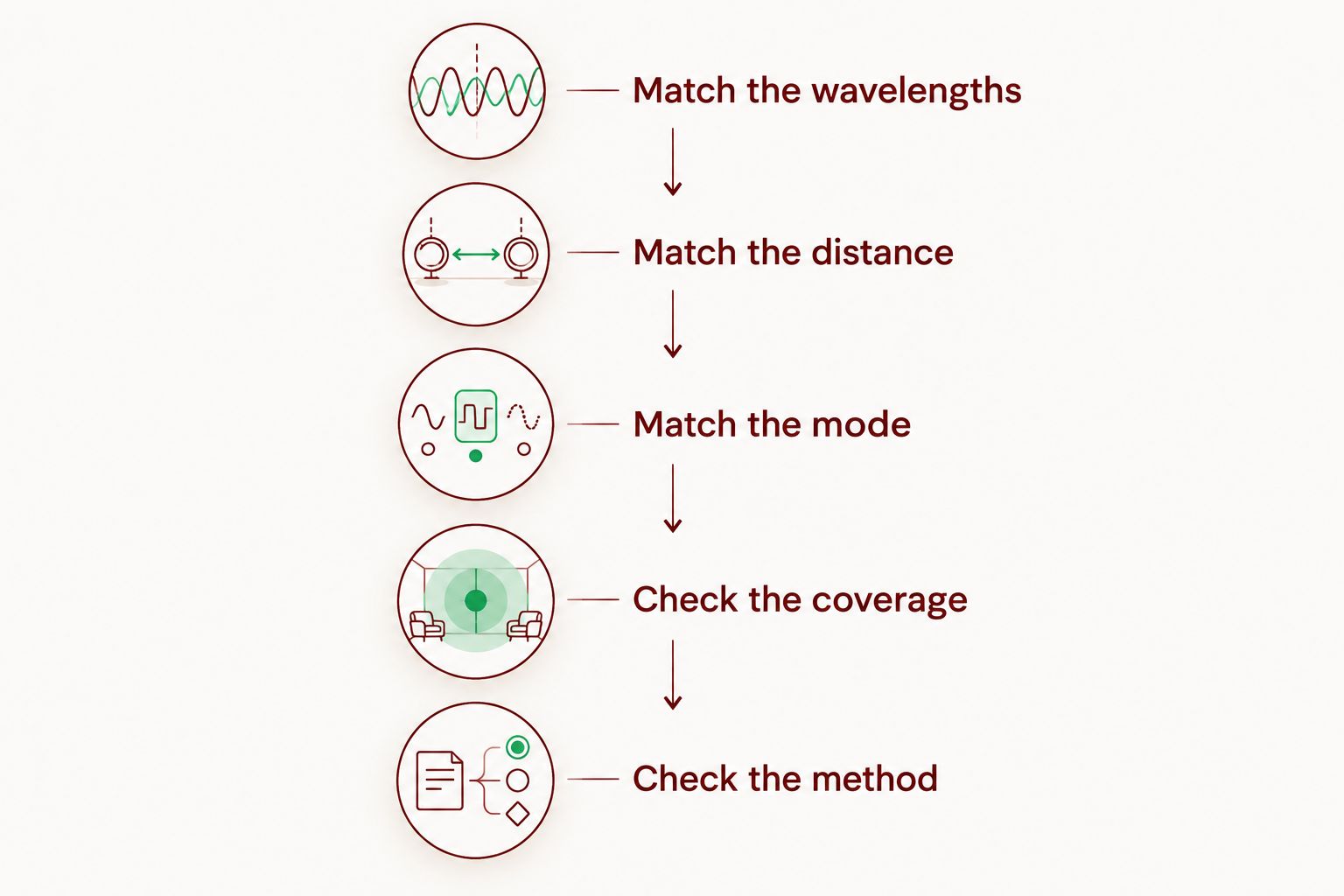
Use this sequence when comparing specifications or asking a supplier for clarification:
- Match the wavelengths. Establish whether the reading includes red light, infrared light or both together.
- Match the distance. Ask where the detector sat relative to the emitting surface, and use that same distance for each comparison.
- Match the mode. Identify which channels were active and whether the device operated continuously or with pulsing.
- Check the coverage. Request readings across the intended illuminated area, not just its brightest point.
- Check the method. Ask for the instrument, its suitability for the wavelengths and the conditions used during measurement.
A specification without these details is incomplete for comparison. Do not turn it into a ranking by adding assumptions about how the measurement was taken.
Why this matters in your home
Picture the place where you will actually use the device: a chair beside a window, a clear section of bedroom wall or a quiet corner after work. The distance between the light and your body belongs in the buying decision, not just in the instruction booklet.
A device that needs a particular position should fit that position comfortably. Otherwise, you are comparing a measurement taken in one arrangement with a routine carried out in another.
For home buyers comparing Suēle red light therapy devices, the best choice is the device with documented output at the position they will actually use. This is a purchase rule, not a claim that one model produces stronger output than another.
Daylight, evening lighting and a dedicated light-therapy session also serve different purposes. Keep those decisions separate rather than treating every red-coloured light as interchangeable.
Irradiance: the light arriving at a surface
Irradiance answers a specific question: how much optical power reaches each unit of area at the measurement position? It does not, by itself, describe coverage, exposure duration or a health outcome.
The unit matters. A figure expressed in mW/cm² is not interchangeable with a value in watts, and a number without a unit cannot support a meaningful comparison. Ask the supplier to identify the quantity rather than interpreting a large number as better performance.
For your 2026 shortlist, record whether each published irradiance figure is a central reading, an average across a defined area or another measurement. These describe different things. A central reading identifies output at that point; an area average describes the measured region, provided the sampling method is explained.
Neither is automatically wrong. The problem starts when a central maximum for one device is compared with an area average for another as though they were equivalent.
Wavelengths: 660 nm is not an output measurement
Wavelength describes the light, not its intensity. Nanometres, abbreviated nm, identify a position in the spectrum; they do not tell you how much light reaches the measurement surface.
The Soleira Panel product description lists 660 nm red light and 850 nm infrared light. The Circā Wrap description lists 630 nm red light. Those details help you identify wavelength differences, but they do not establish which device delivers greater irradiance.
When red and infrared operate together, ask whether a published figure represents their combined output or separate measurements. A combined reading cannot establish how much came from each wavelength unless the report separates them.
Do not judge infrared output by how bright a device looks. Infrared is outside the visible spectrum, so your eyes cannot provide that comparison. Brightness in a photograph is even less useful: camera exposure changes the appearance without changing the device's actual output.
Two home formats: what the specifications still need to show
A lamp and a panel can both belong in a home routine, but their names and product descriptions do not establish a measured-output winner. Compare the evidence attached to each format before choosing around appearance or a headline power label.
| Device | Best for | Relevant supplied information | Purchase consideration | Output question to ask |
|---|---|---|---|---|
| Aurā lamp pro | Buyers considering a lamp-format home setup | Listed as red and infrared light therapy | Check that the lamp can be positioned consistently in your chosen space | What irradiance was measured at the intended distance, and across what area? |
| Soleira Panel | Buyers considering a panel-format home setup | Description lists 660 nm red and 850 nm infrared LEDs | Check positioning, clearance and coverage before committing to the format | Are red and infrared readings separate or combined, and how was coverage measured? |
The practical benefit of a lamp format is that it gives you a lamp-based arrangement to assess; the trade-off is that positioning still needs verification. A panel gives you a different physical arrangement, but its format does not prove even coverage or a particular irradiance.
Do not declare either device the measured-output winner without comparable measurements. Both belong on a format shortlist; neither should receive an output ranking from wavelength labels alone.


Why measured output varies
Different readings can reflect different measurement conditions rather than a meaningful difference between devices. These factors belong beside any output figure:
- Distance and angle: the detector's position changes the light it receives. A directly facing measurement is not equivalent to an angled one.
- Active wavelengths: red-only, infrared-only and combined operation describe different measurement conditions.
- Operating mode: continuous and pulsed operation require clear reporting of whether the figure is peak output or a time average.
- Sampling position: a central reading, an edge reading and an average across an area answer different questions.
- Instrument response: the measuring instrument must be suitable for the emitted wavelengths, with its calibration and method identified.
- Background light: the method should explain how ambient light was controlled or accounted for during measurement.
For a 2026 comparison, keep these conditions in adjacent columns on your shortlist. If the conditions differ, mark the figures as non-equivalent rather than trying to correct them with a guessed conversion.
Do not assume that doubling your distance will reduce output by a particular amount. An extended LED array is not a simple point source at every working distance. Measurements at the positions you intend to use are more useful than an unsupported distance calculation.
What should a useful measurement report include?
A useful report connects the device to a repeatable setup. Look for the model identification, measurement date, active settings, detector position and instrument details. The report should also explain what its headline figure represents.
Ask whether the detector measured optical irradiance and whether its response was appropriate for the device's wavelengths. A reading from an instrument intended for another purpose should not be accepted simply because its display shows a number.
For coverage, request a measurement map or readings at identified positions. A map is useful only if it states the distance, sampled area and settings. Otherwise, coloured squares can make the report look precise without telling you how to recreate the setup.
An independent report offers outside scrutiny, but independence alone does not make measurements comparable. Check the method in the same way you would check a supplier's own report.
For a 2026 purchase, ask for the report date and confirmation that it applies to the model you are buying. A dated document is helpful only when its device and settings match the current product.
Does higher irradiance mean better red light therapy?
Higher irradiance means more optical power per unit area at the measured position under the stated conditions. It does not mean a guaranteed better result, and it does not establish the appropriate exposure for you.
Research on photobiomodulation examines specific wavelengths, exposure conditions and outcomes. Evidence from one protocol cannot simply be transferred to every home device using a similar colour of light.
Separate three questions: what the technology has been studied for, what the particular device delivers and whether the intended use suits your circumstances. A product's output measurement addresses the second question, not all three.
If you have a medical condition, use medicines that affect light sensitivity or intend to treat a health concern, ask a clinician before use. Follow the device's safety instructions rather than building a treatment schedule from an output figure alone.
Can you compare a contact device with a stand-off panel?
A contact device and a stand-off panel need measurements that reflect their different use arrangements. An output figure taken against a emitting surface is not directly comparable with a panel figure measured away from the LEDs.
For a wearable format, ask how output was measured at the intended contact position and across the illuminated surface. For a panel, ask about distance, body position and coverage. Neither format is automatically better; the report must answer the practical question posed by its setup.
Your home routine matters here. Choose an arrangement you can use as instructed without improvising supports, changing the distance or covering ventilation openings.
How do you turn output information into a purchase decision?
Start with your space and intended use, then remove devices whose instructions do not fit that arrangement. Next, compare output documentation under matching conditions. Only then weigh handling, storage and the product's stated support and warranty terms.
When contacting Suēle, ask for measurements for the exact model and operating mode you are considering. Request the distance, wavelengths, sampling area and measurement method together; asking only for the strongest figure invites an incomplete answer.
Keep a dated copy of the specification and instructions with your 2026 purchase records. That gives you a clear reference for setup without relying on remembered claims or screenshots stripped of their context.
FAQ
What's the most useful output specification for red light therapy devices?
Irradiance measured at a stated distance is useful when the wavelengths, operating mode and measurement method are also identified. Check coverage as well, because one reading does not describe the whole illuminated area.
Is a higher-wattage red light therapy device always stronger?
A higher wattage label does not establish higher irradiance at your skin. Electrical power, optical output and the light arriving at a surface are different quantities.
What do 660 nm and 850 nm mean on a red light device?
660 nm identifies red light and 850 nm identifies infrared light. These wavelengths describe the emitted light, not its measured intensity or a guaranteed health benefit.
Can I compare output readings taken at different distances?
Output readings taken at different distances are not directly equivalent. Request measurements at the same distance instead of applying a guessed correction.
Is a centre reading enough to judge a panel's output?
A centre reading describes output at the centre, not across the whole panel's illuminated area. Ask for readings at identified positions or an explained area average.
Can a phone camera measure red and infrared output?
A phone camera does not provide a calibrated irradiance measurement. Image brightness depends on camera settings and spectral sensitivity, so photographs cannot rank device output.
Does a measured output report prove that a device works medically?
An output report describes light delivery under specified conditions; it does not prove a medical outcome. Evidence for a particular use needs a relevant study, not just a strong irradiance figure.
One last thing
The strongest-looking specification is not always the most useful one. A modest-looking figure with a clear, repeatable method tells you more than a larger figure without measurement conditions.
Before buying, ask one final question: does this report describe the position in which I will actually use the device? If the answer is unclear, resolve that first. A simple home routine starts with a setup you understand.